
JB Weld vs. a Real Weld Repair: Will It Hold?
A tube of epoxy in one hand, a cracked trailer in the other. Here's the honest answer from someone who fixes broken metal for a living — and who also keeps JB Weld in his truck.
I get this call a lot. Somebody's standing in the hardware store aisle with a tube of JB Weld in one hand and their phone in the other, and the question is always some version of the same thing: will this hold, or do I need a welder?
Fair question. Here's the straight answer.
What JB Weld actually is
JB Weld is a two-part epoxy. You squeeze out a bead of resin and a bead of hardener, mix them, and a chemical reaction turns the goop into a hard plastic. That plastic grabs onto whatever you smeared it on.
That's the important part: it grabs on. It's glue. Very good glue, engineered to stick to metal and to survive heat and oil better than most, but glue. The bond lives on the surface of your part, in a layer about as thick as a business card.
The name is great marketing. It is not a weld.
What a weld actually is
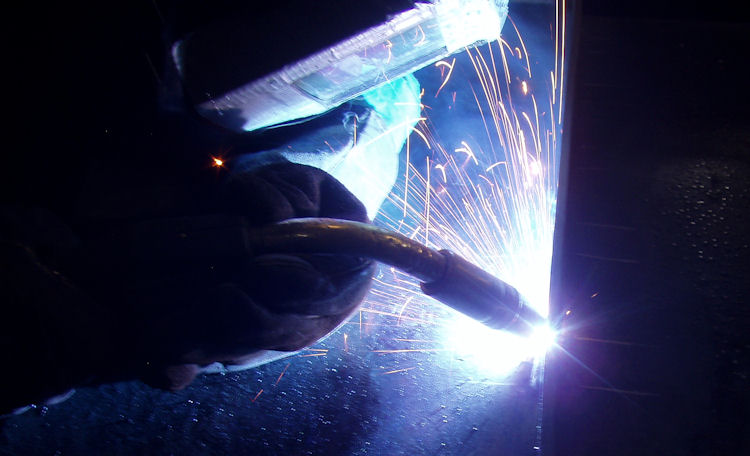
When I weld something, I melt the metal. Both sides of the crack go liquid, a filler metal melts into the puddle with them, everything mixes, and then it cools and freezes solid as one continuous piece.
There's no seam with a glue layer in the middle. There's no "this part and that part." There's just metal. Done right, the repaired area is as strong as the steel around it, and often ends up being the strongest spot on the part.
Epoxy sticks to your part. A weld becomes your part.
So how much stronger is a weld, really?
Here's where most articles start making up numbers. These come straight from the manufacturers.
| Material | Tensile strength | Max temperature |
|---|---|---|
| J-B Weld Original (two-part epoxy) | 6,220 PSI | 550°F |
| J-B Weld KwikWeld (the fast-setting one) | 4,360 PSI | 300°F |
| A36 steel — ordinary structural steel, trailer frames | 58,000–80,000 PSI | — |
| E7018 welding rod — a common repair filler | 70,000 PSI minimum | — |
Even using JB Weld's most favorable published number, a standard welding rod is more than ten times stronger. And that grey tube on the shelf at the auto parts store, the fast-setting KwikWeld, is weaker still and gives up at 300°F — which matters, because people patch exhaust and engine parts with it all the time.
But raw numbers aren't even the real story. Here's why fusion wins where it counts:
- Load spreads out in a weld. Push or pull on a welded part and the force travels through solid metal, the same way it travels through the rest of the frame. With epoxy, all that force transfers through a thin skin of plastic stuck to the outside, and it concentrates right at the glue line.
- Vibration is brutal on adhesives. A trailer doing 65 down I-95 shakes constantly. Steel handles that. A rigid plastic layer bonded to flexing steel starts working loose at the edges, and once the bond cracks, it runs.
- Heat changes epoxy, not steel. Sun on a black trailer tongue, an engine bay, a tool that gets hot in use. Epoxy softens and weakens long before steel notices anything happened.
- Impact is where it ends. Hit a welded joint with a rock and you dent steel. Hit an epoxy patch and it chips off.
When JB Weld is genuinely the right call
I'm not here to trash the stuff. There are jobs where epoxy is smarter than welding, and a few where it's the only safe option:
- Non-structural repairs. A cracked plastic housing, a broken knob, a shop fixture nobody's safety depends on.
- Sealing a weep. A pinhole seep in a non-pressurized tank, or a damp seam that isn't carrying weight.
- Thin sheet metal that welding would blow a hole straight through.
- Two different materials that won't fuse to each other — metal to plastic, metal to ceramic.
- Anything you can't safely put heat near. Fuel tanks, fuel lines, wiring harnesses, painted interiors, fiberglass, brake lines. If sparks in that spot would be dangerous or expensive, epoxy is the adult choice.
- A roadside fix to get home. This one's real. Epoxy has gotten plenty of people off the shoulder and back to the driveway. Just be honest with yourself that it's a bandage, not a repair.
When it will let you down
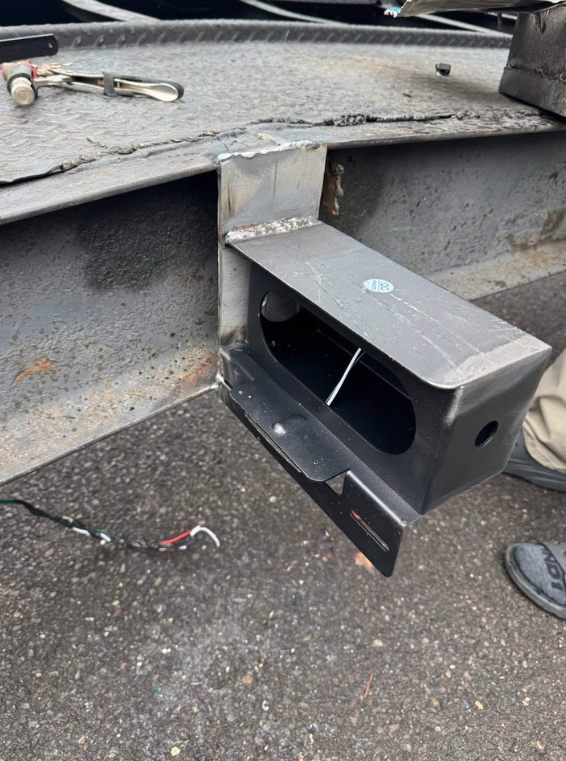
- Trailer frames, crossmembers, tongues, couplers, hitches and safety chain mounts
- Bucket teeth, cutting edges and anything that scrapes dirt and rock for a living
- Anything that vibrates all day
- Anything that gets hot
- Anything holding weight over a person
- Anything with a safety job — towing, lifting, climbing, railings, steps, ramps, ladder racks
On that last group I'll be blunt. If it lets go while you're doing 60 with a loaded trailer, the epoxy isn't what you're going to be worried about.
The quick version
| If your repair is… | Do this |
|---|---|
| Structural or load-bearing | Weld it |
| On a trailer frame, tongue or hitch | Weld it |
| Exposed to heat or an engine | Weld it |
| On a wear surface — teeth, edges, blades | Weld it, usually with hardfacing |
| Sealing a small non-pressure leak | Epoxy is fine |
| Thin sheet metal, cosmetic | Epoxy is fine |
| Plastic, ceramic or two different materials | Epoxy is fine |
| Near fuel, wiring or paint you can't touch | Epoxy, or call and ask first |
| Getting you home tonight | Epoxy, then get it welded |
A word about surface prep
Most epoxy failures I see aren't really epoxy failures. They're prep failures.
The surface has to be bare, rough and clean. Grind down to shiny metal, scuff it so the epoxy has teeth to bite, and get every trace of oil off with a proper solvent — not a squirt of degreaser and a wipe with your glove. Mix both parts thoroughly and let it cure the full time, not the set time. J-B Weld Original sets in 4–6 hours but doesn't reach full cure for 15–24 hours, and cold or humid conditions stretch that out.
Do all that and you'll get the best the product has to give. What perfect prep won't do is change what epoxy is. A beautifully prepped glue joint is still a glue joint.
Questions I actually get asked
Can you weld over JB Weld?
No. It has to come off first, ground back to clean bare metal. Epoxy left in the joint burns, contaminates the puddle and leaves a weak, porous mess — and burning epoxy smoke is nothing you want to breathe. Worth knowing before you reach for the tube: a quick epoxy fix can make the eventual real repair messier and more expensive.
Is JB Weld waterproof?
Depends which one you bought. J-B Weld's own FAQ says resistance to water, fuel and chemicals differs between their products, and WaterWeld is the formulation made specifically for wet repairs. Occasional rain is one thing; constant submersion and freeze-thaw cycles are much harder on an adhesive.
How long does it last?
On a low-stress, well-prepped repair, years. On something that flexes, vibrates or heats up, it can be weeks. The load matters far more than the calendar.
Will it hold a trailer hitch?
No. Don't. That's a welding job, every time.
Can it fix a cracked exhaust or engine block?
An exhaust patch may buy you time, but exhaust runs hot and vibrates hard — treat it as temporary, and check which product you're using against that 300°F or 550°F ceiling. A cracked block is a real repair with real consequences. Get eyes on it before you trust a tube of epoxy with an engine.
Bottom line
Keep JB Weld in your toolbox. It's a good product and it has saved plenty of weekends.
Just know what you're holding. If the repair is structural, loaded, hot, or anywhere near a safety job, it needs to be melted into one piece of metal — not stuck together.
Not sure which one you've got?
Send a photo of the crack and we'll tell you straight — whether it's a weld, or whether the epoxy in your glovebox will do. SES Field Services brings mobile welding and repair to you across CT, NY, MA and RI, with our own power, so the trailer or the machine doesn't have to move.
Sources
- J-B Weld — Original / Twin Tube specifications (tensile strength, temperature range, set and cure times)
- J-B Weld — KwikWeld specifications
- J-B Weld — FAQ (water, fuel and chemical resistance varies by product)
- Lincoln Electric — E7018 electrode data (AWS 70,000 PSI minimum tensile)
- Grade guide: A36 steel (58,000–80,000 PSI tensile)
- Further reading: JB Weld vs. a real weld — whatiswelding.com
Figures are the manufacturers' published values and can change; check the tube in your hand. Nothing here is a substitute for having a failed part looked at.